

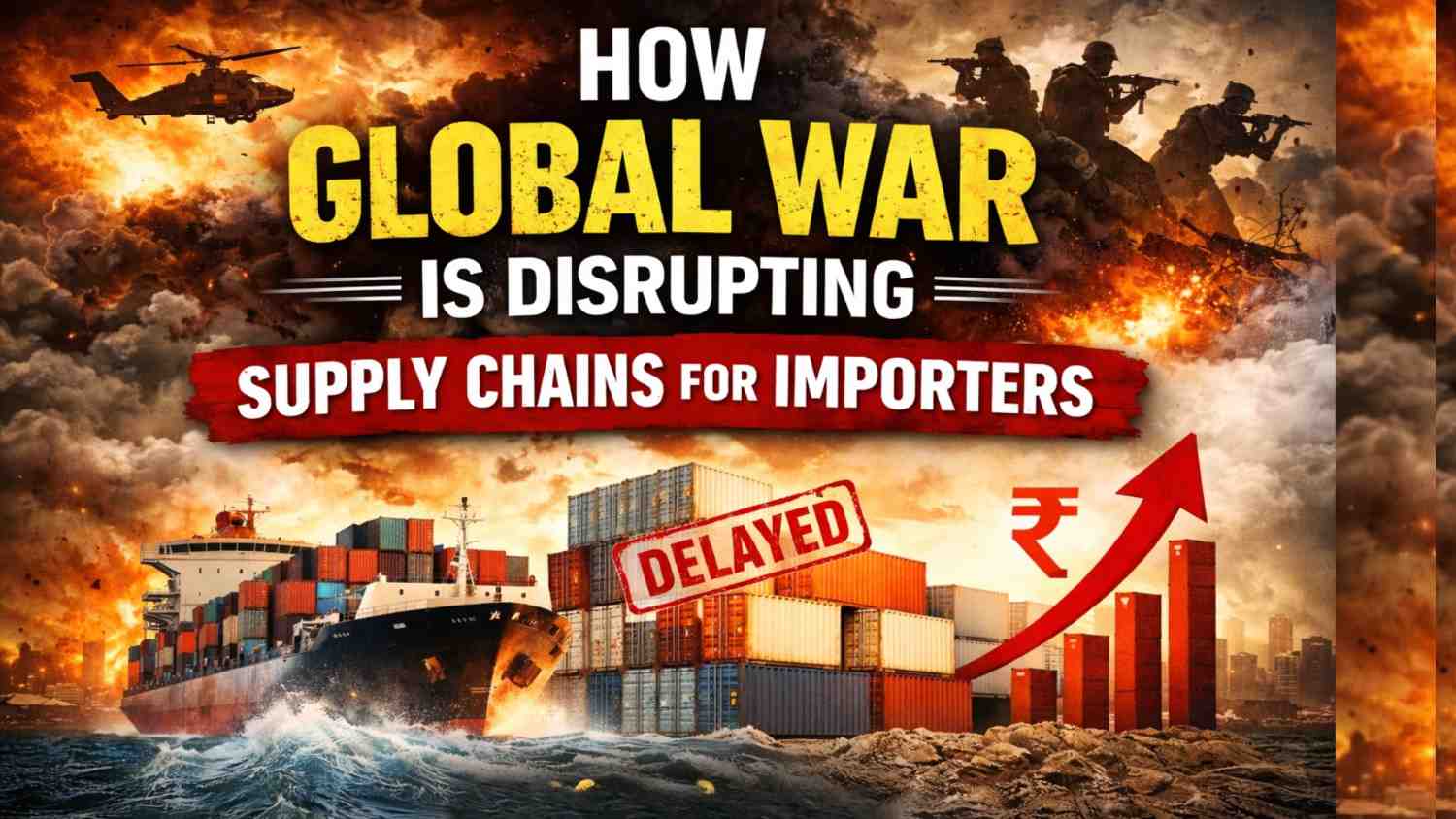
You placed the order. The supplier confirmed. The shipment was supposed to arrive three weeks ago.
Now your phone won’t stop ringing — customers want to know where their goods are, and you don’t have a clear answer.
If this sounds familiar, you’re not alone. Importers across India are dealing with the same situation right now — delayed shipments, rising freight costs, and suppliers who keep pushing timelines. And the root cause isn’t your logistics partner or your vendor. It’s something much bigger: ongoing global conflicts that are quietly reshaping international trade.
This guide explains exactly what is happening, why it is directly affecting your import business, and what you can do to protect yourself in 2026.
Why a War Thousands of Miles Away Becomes Your Problem
Most importers think of global conflicts as something on the news — not something that shows up on their profit and loss statement. But that assumption is costing businesses real money right now.
Modern supply chains are deeply connected. Your goods move through a network of ships, ports, freight forwarders, and overseas suppliers — all of which react to geopolitical instability. When a major shipping lane becomes a conflict zone, the effect reaches Indian importers within weeks, sometimes days.
The simple truth: if your goods travel by sea, and most do, you are already being affected.
How War Actually Disrupts Global Trade
Before getting into the specific problems, it helps to understand the mechanics. Conflict disrupts supply chains in four main ways:
Major shipping routes become unsafe or unusable, forcing ships to take longer alternative paths. Fuel and insurance costs shoot up because of the added risk and distance. Ports face congestion as more vessels reroute through fewer safe corridors. And suppliers in or near affected regions face raw material shortages, energy problems, and labour disruptions — all of which slow down production.
Each of these on its own is manageable. When they hit at the same time, your entire import cycle gets stretched.
6 Supply Chain Problems Indian Importers Are Facing Right Now
1. Major Shipping Routes Are Disrupted
The Red Sea and the Suez Canal handle a significant portion of global trade between Asia, Europe, and the Middle East. Due to ongoing conflict in the region, many shipping lines have stopped using this route entirely.
Ships are now travelling around the Cape of Good Hope in southern Africa — a much longer alternative. What this means for you: 10 to 20 extra days of transit time on shipments that were already scheduled. If you have buyers waiting, or stock running low, those extra weeks hurt.
2. Freight Costs Have Spiked Sharply
Longer routes mean more fuel. Add war-risk surcharges and higher marine insurance premiums on top, and the cost of moving a container has increased significantly compared to even 12 months ago.
This directly increases your landed cost — the total cost of getting goods to your warehouse. If your selling price was calculated on older freight rates, your margins have quietly shrunk.
3. Shipment Delays Are Unpredictable
It is not just the extra transit days that are the problem. Port congestion, vessel rescheduling, last-minute route changes, and carrier equipment shortages mean your shipment’s estimated arrival can shift without any warning.
For importers, this makes planning very difficult. You cannot accurately promise delivery dates to your customers when the shipping side is this volatile.
4. Your Overseas Suppliers Are Under Pressure Too
The disruption does not start at the port. Many overseas suppliers — particularly those in or near conflict-affected regions — are dealing with raw material shortages, rising energy costs, and production delays.
What this means practically: your supplier may confirm an order but quietly push the production date. Or they may revise prices mid-order because their own costs have gone up. These are conversations that are happening more frequently in 2026.
5. Cargo Risk Has Increased
Goods moving through conflict-adjacent shipping lanes face a higher risk of damage, diversion, or extended inspections at ports. Without proper marine insurance coverage, a single incident can mean a significant financial loss with no recovery.
Many importers are underinsured without realising it — standard policies may not cover war-risk or specific route-related damage. Now is the time to review your coverage.
6. Currency Fluctuations Are Adding to Your Costs
Global instability pushes investors toward the US dollar, which means the rupee often weakens during periods of geopolitical tension. If you pay your suppliers in USD, a shift in the exchange rate directly increases your import cost — even if nothing else about the deal changes.
On large orders, even a small currency movement can make a meaningful difference to your final margin.
What You Should Actually Do — Practically
- Stop relying on one supplier.
Nobody wants to make this call when business is running fine. But if your only source for a product is one factory in one country and that country’s export infrastructure gets disrupted — you have no options. Start identifying a backup supplier now. You do not have to place orders with them immediately. Just know who they are and what they can do. - Carry more stock than feels comfortable.
The “just order when you need it” approach works when supply chains are predictable. Right now they are not. If your fastest-moving product takes 45 days to arrive and it is now taking 65, you need more safety stock than you think. Running out of stock is more expensive than holding extra inventory. - Check your insurance policy before your next shipment moves.
Most importers have marine insurance and assume they are covered. Read your policy. Check specifically whether it covers war-risk and what exclusions apply for the current conflict zones. If you are not sure, ask. A single uninsured incident on a large shipment can set your business back significantly. - Lock your freight rate before you confirm your supplier order.
Freight rates are volatile right now. Get a rate from your forwarder before you confirm the order with your supplier — not after. That way your landed cost calculation is based on a real number, not a guess that may have shifted by the time your goods are ready to ship. - Watch the USD/INR rate on large orders.
You do not have to become a forex expert. But if you are placing a large order and the rupee has weakened recently, talk to your bank about whether a forward contract makes sense. Even partial protection on the currency side can save meaningful money on a big shipment.
The Real Problem Is Not the War
The real problem is importing in 2026 the same way you imported in 2022.
The world has changed. The routes have changed. The costs have changed. Importers who are adapting — building flexibility into their supply chains, working with partners who actually communicate, and planning for delays instead of hoping against them — are managing. Importers who are waiting for things to go back to normal are getting squeezed every quarter.
There is no back to normal. There is only figuring out how to work with the reality in front of you.
If Your Shipment Is Already Stuck
Call your freight forwarder and ask for the specific reason — not a general update, a specific reason. Ask which port, which vessel, which routing change. If they cannot tell you, that is itself useful information about whether they are the right partner for you.
If you need a second opinion or you are not sure what your options are, that is exactly what we do at GlobalSolution.co.in.
We work with importers across India — across industries, across source countries — and we have seen most of the situations you are dealing with right now. We will tell you honestly what your options are, what is realistic, and what is not.
Not a sales pitch. Just a practical conversation.
Reach out at GlobalSolution.co.in — and if you are reading this at midnight because a shipment is stuck and you do not know your next move, that is exactly when we are most useful.

