

Apply EPR License in 1 day and get your Custom Clearance
- Consulted 1500 + EPR Registrations
- Free Experts Assistance
- Minimum Price guaranteed
- Quick and Hassle-Free Process
- Free Consultation on Import-Export Compliance
- 20 years experience & Serving more than 4700+ companies
- Providing one stop solution for all Annual compliances
CONTACT US
Our advisor is just a call away
EPR Certificate for End-of-Life Vehicles (ELV) – Your Responsibility, Our Expertise
With India moving swiftly toward environmental sustainability, the End-of-Life Vehicles (ELV) Rules, 2024, have made it mandatory for vehicle manufacturers, importers, and recyclers to take ownership of what happens to their vehicles once they reach the end of their life. This is where EPR (Extended Producer Responsibility) Certification comes into play.
If you’re a part of the automotive ecosystem—whether you manufacture, import, or recycle vehicles—obtaining the EPR Certificate for ELV is not just about regulatory compliance. It’s about making a conscious commitment to our environment and your brand’s future.
What is the EPR Certificate for ELV ?
The EPR Certificate for End-of-Life Vehicles is issued by the Central Pollution Control Board (CPCB) to authorize businesses to manage the collection, dismantling, and scientific recycling of used and obsolete vehicles.
Under the ELV Rules, producers are expected to ensure that vehicles are disposed of safely and sustainably, with minimal environmental impact. This includes building systems for collection, engaging with certified recyclers, and fulfilling annual EPR targets.
Who Needs ELV EPR Certification?
You are required to register for ELV EPR if you fall under any of these categories:
– Vehicle Manufacturers (Cars, Bikes, Commercial Vehicles, etc.)
– Importers of vehicles or vehicle components
– Authorized Vehicle Dismantlers and Recyclers
– Fleet Operators, Cab Aggregators, and Logistics Companies with a large vehicle base
– Auto Parts Suppliers dealing with recyclable components
How Does ELV EPR Registration Work?
We follow a simple and transparent process to help you become EPR compliant:
1. Free Consultation & Eligibility Check
2. Documentation & Application Filing with CPCB
3. Tie-ups with Registered Dismantlers
4. Approval & EPR Certificate Issuance
5. Annual Compliance & Reporting Support
Why is ELV EPR Certification Important?
Old and unfit vehicles contain a large amount of hazardous waste—engine oil, lead batteries, brake fluid, rubber, and plastic. If not handled properly, these can cause serious environmental and health issues.
The ELV EPR certification ensures:
– Environment-friendly vehicle dismantling
– Recovery of reusable metals and materials
– Reduced landfilling and pollution
– Legal protection and reputation boost
– Corporate social responsibility (CSR) recognition
Validity of the ELV EPR Certificate
The certificate is valid for 1 year and can be renewed annually. Renewal depends on:
– Your fulfillment of EPR collection and disposal targets
– Proper submission of compliance reports to CPCB
– Continued partnerships with authorized recyclers
Validity of the ELV EPR Certificate
– Stay Legally Compliant with CPCB & MoEFCC rules
– Boost Brand Image as an eco-conscious business
– Access Government Tenders that require EPR
– Avoid Penalties for non-compliance
– Contribute to India’s Circular Economy
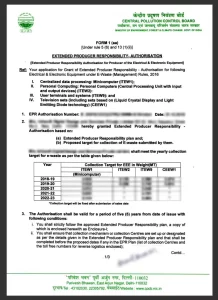
Sample of a Grant Certificate for ELV
Our Partners
We believe to build a strong network of clients and to serve the eco-system with mutual benefits. Some of our esteemed clients are:




















E Waste FAQ
Electrical and electronic equipment EEE means equipment which are dependent on electric current or electromagnetic field to become functional and also the equipment for the generation, transfer and measurements of electricity as addressed by E-WASTE management rules 2022.
E-waste means electrical and electronic equipment, including solar photovoltaic modules or panels or cells, whole or in part discarded as waste, as well as rejects from manufacturing, refurbishment and repair processes.
E-waste contains useful material of economic benefit such as
1. plastic, iron, glass, aluminium, copper,
2. precious metals - silver, gold, platinum, and indium
3. Rare earth elements - lanthanum, neodymium
4. Hazardous substances - lead, cadmium, mercury
5. Toxic substances - polychlorinated bi-phenyls, etched chemicals.
6. The most complex mix of substances is usually present in the printed circuit boards [ PCB ] / printed wiring boards [ PWP ].
E-waste contains hazardous substances such as lead, cadmium, mercury, hexavalent chromium, polychlorinated bi- phenyls [ PCB], brominated flame retardants [ BFR ], polybrominated diphenyl ethers, polybrominated biphenyls.
E-waste can pose a risk to health and the environment if the e-waste is opened -up and
attempts are made to retrieve useful components or materials in a un- scientific manner or if the material is disposed of in the open. the electronic and electrical equipment [ EEE] after their useful life may not cause any harm if stored safely in
households/stores. Stakeholders need to ensure the environmentally sound management of e-waste.
The management of e-waste in India is regulated under e-waste management rules 2022 under the Environment Protection Act 1986. Furthermore, the rules are effective from 1 April 2023.
For addressing e-waste management rules, the 2022 ministry's objective is to ensure that e-waste is managed in such a manner that does not pose any threat to health and the environment which may result from such e-waste.
The merits of the e-waste management rule 2022 are as follows -
a. EPR for producer of electrical or electronic equipment as given in Schedule 1 for meeting the recycling targets as per Schedule 3 and Schedule 4 only through registered recyclers of e-waste to ensure environmentally sound management of such waste.
b. Enforcement of provision regarding reduction in the use of hazardous substances in the manufacture of electrical and electronic equipment.
c.Interaction with the IT industry to reduce hazardous substances.
d.Set and revise targets for compliance with the reduction in the use of hazardous substances in the manufacture of electrical and electronic equipment from time to time.
e.Ensure RoHS compliance and its certifications through a recognized lab and its mandatory checks.
f.106 EEE under seven categories have been covered.
g.Focuses on recycling - e-waste recycling targets an EPR obligation to producers in terms of end products of recycling.
h.Provision for generation of EPR certificate on the EPR portal based on e-waste recycled in terms of four end products [ gold, copper, aluminium, iron ]
i.Producers fulfil their EPR obligation by proportionately purchasing EPR certificates on the portal from registered recyclers.
j.Encouraging re-use of EEE through the generation of refurbishing certificates.
k.Management of solar photovoltaic modules or panels or cells, is included in the schedule however, no recycling target only storage till 2034-35.
l.Provision for imposition and collection of environmental compensation charges in case of violation of any of the provisions of these rules.
m.File quarterly and annual returns by producers.
n.Audit of stakeholders.
E-waste management rule 2022 shall apply to every manufacturer, producer, recycler, refurbisher and dismantler involved in the manufacture, sale, transfer, purchase, refurbishing, dismantling, recycling and processing of e-waste or electrical and electronic equipment listed in Schedule 1, including their components, consumables, parts and spares which make the product operational.
The e- waste management rules 2022 shall not apply to the following -
a. Waste batteries as covered under the battery waste management rules 2022.
b. Packaging plastics as covered under the plastic waste management rules 2016.
c. micro-enterprise as defined in the Micro, Small and Medium Enterprises Development Act 2006 [ 27 of 2006 ].
d. Radio-active wastes as covered under the provision of the Atomic Energy Act 1962.[33 of 1962 ] and rules made there under.
Manufacturer means a person or stakeholder or a company as defined in the Company Act 2013 [ 18 of 2013 ] or a factory as defined in the Factories Act 1948 [ 63 of of1948 ] or Small and Medium Enterprises Development Act 2006 [ 27 of 2006 ] which has facilities for manufacturing of electrical and electronic equipment as specified in Schedule 1 as addressed by e- waste management rule 2022.
Producer means any person who irrespective of the selling technique used such as dealer, retailer, and e-retailer as addressed by e-waste M rule 2022.
a.Manufactures and offers to sell electrical and electronic equipment and their Components or consumables or parts or spares under its brand.
b. Assembled electrical and electronic equipment and their components or consumables or parts or spares produced by other manufacturers or suppliers.
c. sell imported electrical and electronic equipment and their components or consumables
or parts or spares.
d. Who imports used electrical and electronic equipment
Refurbisher means any person or stakeholder repairing or assembling used electrical and electronic equipment as listed in Schedule 1 for extending its working life over its originally intended life and for the same use as originally intended and selling them in the market.
Recycler means any person or stakeholder who is engaged in recycling and reprocessing of waste electrical and electronic equipment or assemblies
or their components or their parts for recovery of precious, semi-precious metals including rare earth elements and other useful recoverable materials to strengthen the secondary sourced materials and having facilities as addressed by CPCB.
Recyclers and refurbishers can collect e-waste from anywhere in the country for the purpose of recycling or refurbishing.
RoHS is the abbreviation for reducing hazardous substances in the manufacture of electrical and electronic equipment. every producer needs to ensure that electrical and electronic equipment and their components do not contain lead, mercury, cadmium, hexavalent chromium, polybrominated biphenyls, or polybrominated diphenyl ethers.
In compliance with the e-Waste Management Rule 2022, electrical and electronic equipment must not contain lead, mercury, cadmium, hexavalent chromium, polybrominated biphenyls, or polybrominated diphenyl ethers beyond a certain maximum concentration values in homogenous materials: 0.1% for lead, mercury, hexavalent chromium, polybrominated biphenyls, polybrominated diphenyl ethers, and 0.01% for
cadmium.
The RoHS provision in the e-waste management rules for 2023 states
a. Sub-rule 16 doesn't apply to components, consumables, parts, or spares for electrical
and electronic equipment in Schedule 2b, if placed in the market by May 1, 2014,
unless compliant parts and spares aren't available.
b. Sub-rule 16 doesn't apply to electrical and electronic equipment specified in schedule
2c if placed in the market by April 1, 2025.
c. Sub-rule 1 doesn't apply to components, consumables, parts, or spares for electrical
equipment in schedule 2c until April 1, 2028, unless compliant parts and spares are
available.
Producer while seeking EPR registration is required to submit the following declarations
Self-declaration of producer that EEE produced by the producer is complying with the RoHS as per sub rule of rule 16 of the e- waste management rules 2022.
Declaration on availability of technical documents on RoHS are available with producers and will be made available for verification to the officials of CPCB / SPCB.
Solar photovoltaic modules or panels or cells are also covered under e-waste
Management Rule 2022. Every manufacturer and producer of solar photo- voltaic
modules or panels or cells shall store the waste they generate up to the year
2034-2035 as addressed by CPCB.
Extended producer responsibility means the responsibility of any producer of electrical
or electronic equipment as given in schedule 1 for meeting the recycling target as per
schedules 3 and 4 only through registered recyclers of e-waste to ensure
environmentally sound management of such waste.
For the fulfilment of the EPR obligation, producers are required to acquire an EPR
certificate from registered recyclers as addressed by CPCB.
Producers have given phase-wise EPR obligations or recycling targets for e-waste. EPR
obligations are effective from 1 April 2023 and for the FY 2023-2024 & FY 2024-2025, it is
60 % of the quantity of waste generation, followed by 70% during FY 2025-2026 & FY
2026-2027, 80 % during FY 2027-28 and onwards.
a. E-waste recycling target shall be reviewed and may be increased after the end of year
2028- 2029.
b. The importers of used electrical and electronic equipment shall have a 1000 % extended
producer responsibility obligation for the imported material after the end of life, if not
re-exported.
c. e- waste recycling target shall not be applicable for waste generated from solar
photo-voltaic modules or panels or cells.
In case the producer has started sales recently, EPR obligation shall be applicable as per
schedule 4 and these targets are applicable from FY 2023-24 and are 15% of the sales in
2021-2022 and for FY 2024 -25 20 % of the sales in FY 2022-2023 and FY 2025-2026
onwards, it is 20% of the sales figure of the financial year two years back.
Registered producer, recycler and refurbisher of e-waste register on the CPCB portal
can collect e- waste as addressed by e- waste management rules 2022.
A recycler has to ensure that the fractions or materials not recycled in its facility are sent
to the respective registered recyclers. also, the residue generated during the recycling
process is to be disposed of in an authorized treatment storage disposal facility. a
recycler is required to maintain a record of e-waste collected, dismantled, recycled and
sent to a registered recycler on the portal and make available all records for verification or
audit as and when required.
CPCB has prepared an SOP for stakeholders for filing -up, processing & evaluating
applications seeking registration. the SoP elaborates on the information required to be
provided in the application and also details the documents required to be submitted by an
applicant while seeking registration. the SoP have also defined various timelines involved
in the grant of registration.
A manufacturer of EEE listed in Schedule 1 and a refurbisher of e-waste of the rules shall
register itself on the e-waste EPR portal. the manufacturer and refurbisher should have
valid CTO under the Air & Water Act along with authorization under the hazardous and
other waste rules, 2016 from the concerned SPCB. the requirement of CTO is exempted
for the white category industry.
In case of the addition of EEE items in their existing producer registration. the producer is
required to follow the below-mentioned steps.
a. GO to the amendment section
b. Create amendment
c. select addition of EEE
d. Revised Table- 1 [ Table -1 should also have the sales data for EEE items for which
the producer has already been granted EPR registration, and sales data in Table 1
should not be contradictory].
e. Self-declaration on RoHS compliance with revised enclosure -A
f. Declaration on availability of technical documents on RoHS.
In case of a change of company name and address in their existing EPR registration certificate. the producer is required to follow below mentioned steps -
Go to the amendment section
Create amendment
Select name change
Revised GST certificate
Revised IEC certificate
The fee structure of producer, recycler, refurbisher & manufacturer and annual
maintenance charges for all stakeholders for registration on the EPR portal under e-
Waste Management Rules 2022 is mentioned in Annexure 1.
CPCB has developed a framework for the generation of EPR certificates under the e-
Waste Management Rules 2022. The framework provides details on the procedure for the
generation of the EPR certificate, key metals for the generation of the EPR certificate,
and modalities for the fulfilment of EPR obligations.
The average material composition of key metals namely gold, iron, copper & aluminium in
terms of weight in 106 EEE have been estimated by CPCB in consultation with the
concerned stakeholder at e- waste EPR portal under the SOP
A producer shall fulfill their EPR obligation through the online purchase of an EPR
certificate from a registered e- waste recycler.
The EPR obligation is independent of the EEE code. However, the producer has to ensure
the capability recycler to recycle the EEE code for which the producer has been assigned
an EPR obligation.
The maximum quantity of EPR certificate producer may purchase is as follows
X + 0.5x+y
X - EPR obligation in the form of end product [ fe, cu, al & au ]
Y- any leftover liability
In case a producer purchases an EPR certificate for gold more than EPR obligation wrt
gold X au + nXau where xau is EPR obligation in terms of gold, xcu is EPR obligation in
terms of copper, xal is EPR obligation in terms of aluminium and n= % surplus quantity of
gold certificate . as per rules surplus quantity of gold cannot be more than 5%. the
producer has two options.
The producer may opt to reduce EPR liability for gold by nxaukg in the next f/y for that particular EEE item
A Surplus EPR certificate of gold will be used to fulfill the EPR obligation of cu & al for current f/y
Epr obligation will be treated as complete wrt cu and al
If the minimum EPR certificate purchased wrt cu & al are
Xcu -nxcu and xal-nxal
A maximum quantity of EPR certificate producer may purchase wrt cu and Al will be
Xcu -nxcu+0.05xcu+y and xal-nxal + 0.5xal +y
Y- any leftover liability.
In case a producer purchases an EPR certificate for less than the EPR obligation wrt gold
Xau-nxau where xau is EPR obligation in terms of gold, xcu is EPR obligation in terms of
copper, xal is EPR obligation in terms of aluminium and n= % deficit quantity of obligation
in the form of gold. the producer has two options
The producer may o[pt to increase epr liability for gold by nxau kg in the next fy for that particular EEE item
EPR obligation will be treated as complete if the quantity of EPR certificate purchased wrt cu and al for current f/y are -
Xcu + nxcu and xa + nxal
The maximum quantity of EPR certificate producer may purchase wrt cu and al will be
Xcu + nxcu +.05xcu +y and xal + nxal +.05 xal + y
Y - any leftover liability.
Under the framework for the generation of EPR certificates EPR obligations wrt gold have
been reduced only for producers. however, recyclers can obtain gold from e-waste as
required to do optimal recycling for gold and provide gold credits to the producers.
A recycler is required to maintain the record of other materials also for mass balance.
the information about other materials to be furnished when filing the return.
The E-waste EPR portal is accepting data wrt e- waste processed from 1 April 2023 and
credit on the same is also getting generated accordingly.
CPCB issued notice on 15 .06. 2023 stating that recyclers are required to generate an EPR certificate through the EPR portal.
In the case of e-waste purchased from the formal sector, the recycler is required to
upload the sales invoice of the seller. in case e-waste is purchased from the informal
sector, the recycler is required to upload any sales receipt or any sales receipt having the
name and address of the seller.
A recycler is required to collect full equipment for recycling collection of the entire
equipment will ensure its recycling in a proper scientific manner. collection of
parts/spares will lead to the recycling of only those spares/components while the
remaining parts/components may remain unrecycled or go to the informal sector. In case
a recycler does not have a facility for recycling all the material then the same may be
given to another registered recycler having a facility for its recycling and maintain data wrt
same.
Yes, it is mandatory to mention commodity weight in the seller invoice issued to the recycler
at the time of purchase of e-waste.
GST-linked sales Invoice is mandatory to verify the proof of selling the recycled metals
[ end product ]
Grant or renewal of epr registration processing fees for producers seeking epr registration under e- waste management rule 2022.
Annual e-waste recycling target [ MT] proposed charge
< 50 mt - 2500
50 mt to < 100 mt - 7500
100 mt to < 1000mt - 1,50,000
1000mt to 5000mt - 15,00,000
b. For producers whose sales just started, the processing fee will be Rs 10,000
c. amendments in existing EPR registration in terms of addition of EEE items, revision in the recycling target, conversion from EPR Authorization [ producer granted EPR authorization / renewed EPR authorization in online mode to EPR registration the processing fee will be Rs 10,000/-.
The fee structure for registration of recycler, refurbisher & manufacturer and annual maintenance charges for all stakeholders for registration on the EPR portal under e- waste management rules 2022.
a.New recycler [ 1 time registration valid for 5 years ] - Rs 15000
b.Renewal of registration [ after 5 years ] - Rs 7500 + Rs 0.625 / mt for quantity of
EPR certificate transaction in the
preceding five years.
c.in case of any amendments/addendum - Rs 3000
a.newrefurbisher [1-time registration -valid for 5 years ] - 15,000
b. Renewal of registration [ after 5 years ] - 7500 + 0,625/mt for the quantity of
refurbishing certificate transactions
in the preceding five years.
c.in case of any amendment /addendum - 3000
One-time registration - 15,000
Annual maintenance charges for all stakeholders
Annual maintenance charges for producers, recyclers, and refurbishers - 5,000
and manufacturer

